Artist Statement
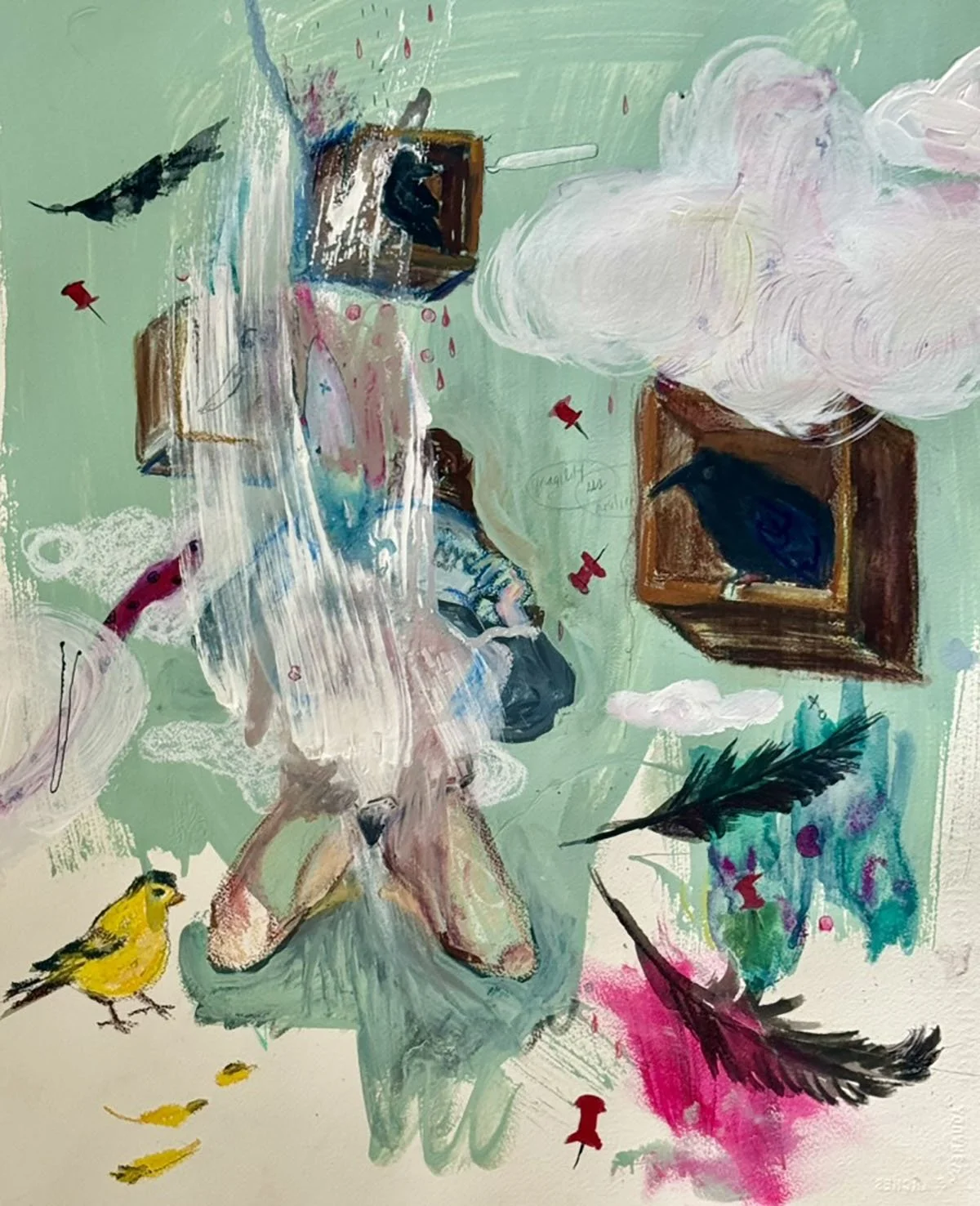
My paintings begin with the impulse to contain experience: to name it, pin it down, put it inside a house, a story, a relationship, or an image. But containment repeatedly fails. I build paintings from fragments of lived experience, memory, private jokes, emotional debris, and the small details that become inexplicably important after something has happened. Birds, feathers, pushpins, envelopes, houses, clouds, fire, food, animals, weather, and other recurring forms move from painting to painting. Their meanings are unstable. A finch can begin as an ordinary bird and become a witness. A pushpin can hold something in place until it cannot. A small betrayal can acquire wings. I am interested in the strange disproportion of memory: how an insignificant object can come to carry the weight of an entire relationship, while something enormous can become strangely peripheral. In the paintings, scale follows emotional significance rather than physical reality. Houses become tiny beneath enormous weather systems. Messages float without recipients. Birds escape frames. Domestic spaces are invaded by clouds, animals, water, and fire. The paintings construct worlds in which the boundaries intended to organize experience are continually being breached. Humor is essential to this work. I use absurdity as a way of approaching experiences that are otherwise difficult to hold. The titles often sound overly specific, mock-authoritative, or certain: She Came Unpinned; Julie Knows. The Finch Didn’t Lie; Muggle Date, Sardine Fate: Romantic Until Proven Otherwise. They attempt to classify events that resist classification. The paintings undermine that certainty almost immediately. I think of these works as a developing private mythology. Personal events provide the raw material, but painting transforms them. Details detach from their original stories and become symbols available to other meanings. I am less interested in documenting what happened than in what happens afterward—how desire, grief, betrayal, tenderness, uncertainty, and memory are rearranged by the mind until they become something stranger than autobiography. The act of painting is part of that transformation. Marks are layered, obscured, scraped through, painted over, redrawn, and allowed to remain unresolved. Images emerge and disappear. Drawing interrupts painting; recognizable objects interrupt abstraction. I want the surface to retain evidence of revision rather than arrive at a perfectly resolved account.
Ultimately, these paintings are about the failure, and perhaps the futility, of keeping experience in the categories we assign to it. Relationships change their names. Memories change their meanings. Symbols migrate. What was supposed to remain contained escapes, but I am beginning to wonder whether containment does not only fail. It can also open. A seam can rupture, but it can also unzip. What emerges through that opening can become material: something carried forward, transformed, and used for nourishment.